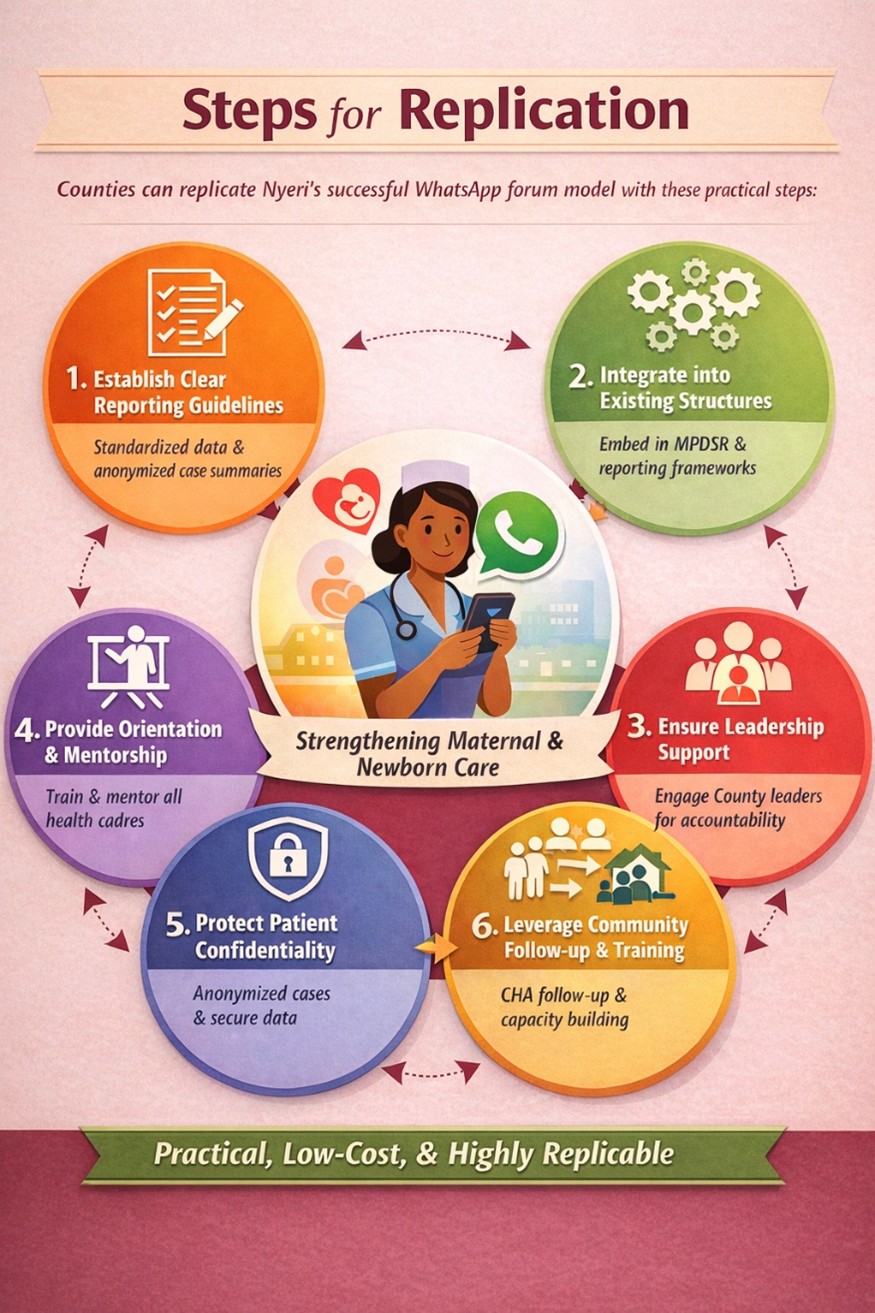
Effective communication between health facilities is critical for improving maternal and neonatal outcomes, particularly in resource-constrained settings. Traditional referral systems often lack timely feedback and continuity of care, resulting in information gaps that compromise patient management. These gaps especially affected expectant women and newborns referred from primary care facilities through to County and National referral hospitals, leading to delayed interventions, missed case reviews, and reduced quality of care.
Within Kenya’s devolved health system, effective implementation of Maternal and Perinatal Death Surveillance and Response (MPDSR) remains central to improving maternal and newborn outcomes. While MPDSR frameworks are well established, Counties continue to face systemic challenges in ensuring timely case notification, coordinated review, and consistent follow-through on response actions across the continuum of care. Delays in information sharing limited two-way feedback between referring and receiving facilities, and inconsistent documentation continue to constrain MPDSR effectiveness.
To address these challenges, the Nyeri County Department of Health established a WhatsApp forum linking maternity nurse-in-charges, Sub-County public health nurses, medical specialists, and community health teams across all County health facilities. The forum enables real-time case discussions, strengthens referral pathways, fosters collaborative learning, and improves continuity of care. Embedded within MPDSR governance structures, it functions as a coordination layer rather than a parallel system, leveraging a low-cost mobile messaging platform to facilitate timely information exchange, accountability, and high-quality data reporting.
Governance and Data Protection
The platform is led by the County Reproductive Health Unit under the oversight of the County Health Management Team (CHMT), linking maternity units, sub-county teams, specialists, and community health structures across public, private, and faith-based facilities. This structure enables coordinated engagement across all levels of service delivery while remaining fully embedded within existing MPDSR governance frameworks.
The CHMT retains full control over group membership and access, with defined protocols guiding participation and information sharing. All case discussions are anonymized, with no patient identifiers, and aligned to role-based engagement and the provisions of the Data Protection Act, 2019. This governance framework ensures that real-time information exchange supports MPDSR processes while maintaining confidentiality, accountability, and trust across participating facilities.
How the Forum Works:
Step 1: Daily data posting
Each facility’s maternity nurse-in-charge, who also serves as the MPDSR secretary, posts standardized daily data on the WhatsApp forum by 9.00 a.m. Data includes deliveries, macerated and fresh stillbirths (MSBs/FSBs), neonatal and maternal deaths, babies born before arrival (BBAs), referrals, and low birthweight cases.
At the Sub-County level, public health nurses consolidate facility-level data and post summary reports for their respective areas, providing a broader overview of trends and outcomes. Zero reporting is done when there are no cases, ensuring continuous surveillance.
Step 2: Case summaries for adverse outcomes
For adverse events, including MSBs, FSBs, neonatal or maternal deaths, brief summaries are shared outlining how the patient was managed and any gaps identified. For referrals, summaries include patient details, clinical management provided, ambulance response time, and outcomes from the receiving facility. No patient names or identifiers are shared, and abbreviations are used to protect privacy.
Step 3: Critical review and discussion
Forum members review posted data and engage in open discussions to identify gaps, solve problems, and take immediate corrective action. The forum brings together a multidisciplinary team including county leadership, obstetricians, paediatricians, neonatologists, pharmacists, laboratory technologists, ambulance teams, medical officers, nurses, clinical officers, nutritionists, community health coordinators, and Community Health Assistants from public, private, and faith-based facilities.
Discussions often go beyond the clinical event. For example, one case prompted review of antenatal care attendance, cling film wrapping for thermal care of a newborn, and immunization status of a nine-month-old baby, highlighting missed prevention opportunities and strengthening adherence to maternal and child health protocols.
Step 4: Specialist technical guidance
Medical specialists actively participate by providing technical guidance in their areas of expertise, clarifying clinical decisions, and offering recommendations for improving patient management.
Step 5: Community follow-up
Any issues that require community-level intervention are forwarded to a parallel WhatsApp group of Community Health Assistants (CHAs), who follow up at the household level to ensure continuity of care.
Step 6: System-level analysis and interventions
All discussions and case summaries are analyzed to identify systemic gaps and recurring issues. The Reproductive Health Coordinator compiles monthly summaries and compares them with Kenya Health Information System data, achieving over 95% consistency. Referral confirmations by receiving facilities further strengthen data accuracy.
Insights from the forum have led to targeted actions such as:
- Two-week mentorship and clinical rotations for nurses and clinical officers from Level 3 facilities in Level 4 and Level 5 hospitals.
- Community mapping and ANC follow-up, ensuring pregnant women receive adequate antenatal care
Results
- Real-time monitoring: Daily standardized reporting through the WhatsApp forum enables early identification of adverse outcomes and emerging trends. Health workers and county leadership can quickly detect issues such as maternal or neonatal complications, stillbirths, or referral delays, allowing for timely interventions and improved patient outcomes.
- Accountability and transparency: Case briefs shared on the forum highlight management gaps and prompt immediate discussions among multidisciplinary teams. This transparency fosters a culture of accountability, encourages shared problem-solving, and ensures that corrective actions are taken promptly when gaps in care are identified.
- Improved referral coordination: Structured referral briefs, along with feedback from receiving facilities, have strengthened continuity of care and reduced information loss during patient transfers. As a result, average ambulance response times have improved from 1 hour 50 minutes to 1 hour 30 minutes, ensuring that mothers and newborns receive critical care more rapidly and efficiently.
- Community linkage: Issues identified at the facility are transferred to CHAs for household follow-up. This ensures continuity of care from the facility to the home, supports adherence to postnatal care and immunizations, and strengthens the overall connection between health facilities and the communities they serve.
- Quality improvement and capacity building: Peer discussions on the forum clarify clinical terminology, strengthen case analysis, and foster a culture of collective problem-solving among healthcare providers. Specialists provide mentorship and guidance, helping frontline staff improve their skills, make better clinical decisions, and build confidence in managing complex maternal and neonatal cases.
- Data Quality: Monthly comparisons between WhatsApp forum submissions and the Kenya Health Information System (KHIS) reports show over 95% consistency, demonstrating that the forum supports reliable, high-quality data. Referral cases are also verified by receiving facilities, further ensuring accuracy and trust in the system.
What initiative has your County taken to improve maternal and neonatal care? We would love to hear your story.
Visit https://maarifa.cog.go.ke/ to learn more about the successful initiatives on service delivery our Counties are undertaking.
Compiled by: Agnes Gichogo - Nyeri County Reproductive Health
Dr. Nelson Muriu - Nyeri County Director, Medical Services & Public Health
Dr Esther Njeri – Paediatrician, Nyeri County
Dr. Simon Mbirua – Council of Governors, Health Committee
Mercy Gatabi - Council of Governors, Maarifa Centre